Dr. Grigoriy Mashkevich, 925 Park Avenue
Deep plane facelift and neck lift in Manhattan
A deep plane facelift releases the ligaments that tether the cheek and lifts skin, fat and the SMAS layer as one unit.
Dr. Grigoriy Mashkevich performs the deep plane facelift at 925 Park Avenue, usually together with a neck lift. The deeper release moves the cheek fat and jowl upward with the skin, and the skin itself is not pulled tight, which helps the face avoid a stretched look. Most patients resume light daily activity after two to three weeks.
- Double board-certified facial plastic and reconstructive surgeon
- UCLA facial plastic surgery fellowship
- Icahn School of Medicine at Mount Sinai affiliation
How does a deep plane facelift work?
The surgeon works beneath the SMAS, the layer of muscle and fibrous tissue under the facial fat, and frees the ligaments that tether the cheek.
Skin, fat and SMAS then move up together. A SMAS facelift tightens or folds the SMAS and leaves those ligaments in place. The cheek fat moves less with that approach.
The incisions run in the crease in front of the ear and continue behind it into the hairline, as in a traditional facelift.
After an earlier SMAS facelift, a deep plane facelift is still an option. The deep plane technique works in tissue that the first operation largely left untouched, so that part of the face and neck can be released safely.
Who is a candidate for a deep plane facelift?
Good candidates have loose skin and fat along the jawline and neck, are in good general health and have realistic expectations.
- Jowls that blur the line of the jaw
- Loose skin or vertical bands in the neck
- Cheek fat that has dropped toward the fold beside the mouth
Smoking slows wound healing, and aspirin and other blood thinners raise the chance of bleeding. Both are reviewed at the consultation.
There are no absolute contraindications to a deep plane facelift. After many filler injections or earlier surgery in the same area, the dissection has to protect important structures: the facial muscles, the facial nerve and the parotid (salivary) duct.
A facial nerve monitor may be used during surgery to protect the branches of the facial nerve. If heavy scarring is found, the dissection may stop at its safe limit.
Does a deep plane facelift include a neck lift?
Usually yes, because the SMAS of the face continues into the platysma, the thin muscle of the neck.
Through the facelift incisions, the platysma is lifted back toward the ear. When the neck needs it, a short incision under the chin is used to tighten the vertical bands and remove fat.
Some necks need deeper work, depending on the anatomy. This can include removing part or all of the fat beneath the platysma and reducing the digastric muscles under the chin. The submandibular (salivary) glands can also be shaved when they bulge.
What is recovery like after a deep plane facelift?
Most patients return to work after about two weeks and to light daily activity after two to three weeks. Cardio waits about four weeks.
- Days 1 and 2The dressing comes off within one to two days, and any drains come out on day one or two. Keeping the head raised and using cold compresses help with swelling.
- Days 5 to 10Stitches and staples are removed between day 5 and day 10.
- Weeks 2 and 3Bruising fades, and most patients are back at work at about two weeks.
- Months 3 to 12Swelling goes down further, and the incision lines fade as the scars mature.
During the first week, avoid strenuous activity, including heavy lifting and anything that makes you sweat. Walking, light stretching, rest and comfortable positioning help recovery. Every patient has nursing care for the first 24 to 48 hours, depending on need.
Every patient receives Dr. Mashkevich's direct phone number. He checks in on the first and second days after surgery, and as needed until the first visit back on day 7.
On day 3 or 4, an assistant visits to help with washing the hair and a full shower. Patients also send photos of the face and neck, so Dr. Mashkevich can confirm that healing is on track.
How much does a deep plane facelift cost in Manhattan?
The fee depends on the surgical plan, and Dr. Mashkevich gives a written quote after the consultation.
Skin quality, the depth of the jowls and neck, the underlying bone structure and any earlier surgery all shape the plan, and the plan sets the fee.
The consultation at 925 Park Avenue is private and unhurried. The fee is discussed there in detail, and you leave with a written quote.
To arrange a consultation, call (212) 737-8700 or use the request form at the end of this page.
The quote reflects these parts of the plan.
- Whether a neck lift or other procedures are added
- Anesthesia and operating room fees
- The length of the operation
- Revision cases, which often take longer
What are the risks of a deep plane facelift?
Serious complications are rare, but any facelift has risks, including bleeding under the skin, nerve injury, infection and scarring.
- Bleeding under the skin (hematoma) or a fluid collection (seroma)
- Injury to a branch of the facial nerve, with weakness that is usually temporary and rarely permanent
- Numbness or other changes in skin sensation
- Infection, poor wound healing or skin loss
- Visible scars, or hair loss near the incisions
- Asymmetry, or a result that needs a second procedure
- Anesthesia risks, blood clots and heart or lung complications
Each risk is reviewed at the consultation, and the consent form lists them in writing.
Which procedures are often combined with a facelift?
Fat grafting, implants, lip lift and laser resurfacing each treat a part of the face that a facelift does not adequately address.
Aging brings sagging of the face and neck, and also a shift in volume as fat shrinks and bone recedes. The change shows most in the temples, around the eyes and in the cheeks.
The upper lip can stretch and lose volume with age. When the upper front teeth no longer show, the face and smile look less youthful.
The corners of the lips can also droop and hide the red part of the lip near the corners of the mouth. A central lip lift and a corner lip lift improve these areas, with a conservative addition of fat for any volume loss.
Fat grafting can restore hollow temples and cheeks, and carefully selected implants suit advanced cases.
Ablative laser resurfacing treats surface wrinkles, with the goal of improving the texture and elasticity of the skin.
Hollow temples: filler, fat grafting or a temple implant
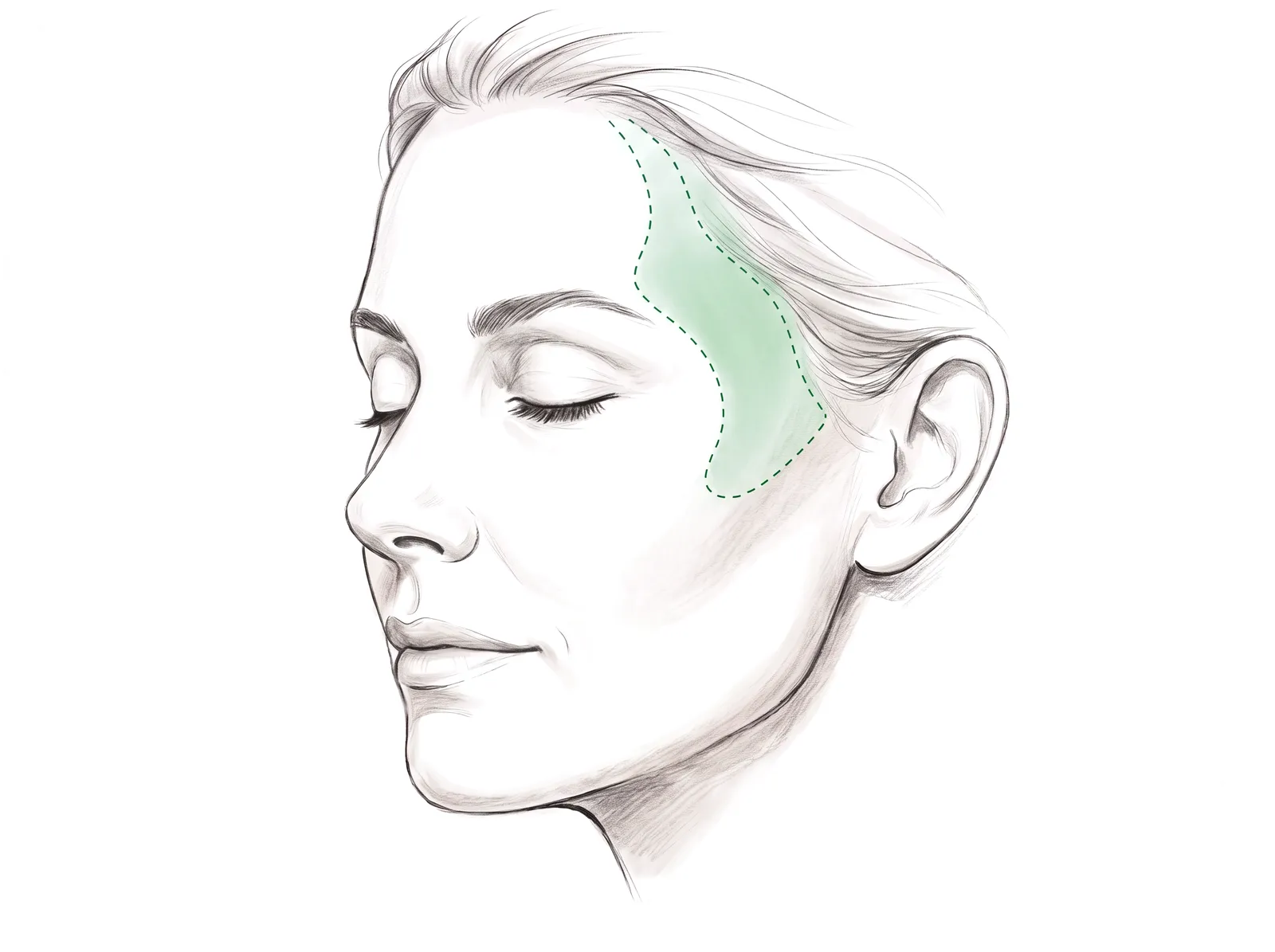
A hollow temple makes the upper face look aged, and a lift does not fill it. Volume returns in one of three ways.
Filler: no incision. The result lasts 6 to 12 months, often with only partial correction. The anatomy of the temple makes it hard to fill evenly.
Fat grafting: the patient's own fat, often placed during the facelift. Part of it is absorbed over the first months, and the fat that remains lasts a long time. As with filler, full correction is hard to achieve.
Temple implant: a soft silicone implant placed through a small incision behind the hairline, often during the same operation as the facelift. It does not wear off, gives the fullest correction and can be removed easily if needed.
For a hollow temple, an implant gives fuller correction and a longer-lasting result than grafting the patient's own fat.
Chin implant for the jawline
A small chin can leave the jawline short even after the jowls are lifted. A chin implant placed through a short incision under the chin lengthens the jawline and sharpens the angle between the jaw and the neck.
Fat grafting
Fat taken by gentle liposuction, usually from the abdomen or thighs, is injected to restore volume in the cheeks, temples or under the eyes. Part of the grafted fat is absorbed over the first few months, and the remaining fat is long-lasting.
Lip lift
With age, the distance between the nose and the upper lip grows longer and the lip thins. A lip lift removes a strip of skin under the nose to shorten that distance and show more of the upper lip.
Laser resurfacing
A facelift repositions tissue but does not change the texture of the skin. Laser resurfacing treats fine lines, sun damage and uneven texture, during the facelift or a few months later.
Complex and revision cases
A revision facelift, or a face with scarring from earlier surgery, needs a plan that accounts for tissue already moved.
About one in five of Dr. Mashkevich's facelift patients come to him after a facelift elsewhere.
Dr. Grigoriy Mashkevich
Dr. Grigoriy Mashkevich is a double board-certified facial plastic and reconstructive surgeon at Specialty Aesthetic Surgery, 925 Park Avenue.
- MD, Albert Einstein College of Medicine
- Head and neck surgery training, then nearly a decade on the faculty at New York Eye & Ear Infirmary
- Facial plastic and reconstructive surgery fellowship, UCLA
- Affiliated with the Icahn School of Medicine at Mount Sinai
Facelift cases
Before-and-after cases are being prepared and will appear here.
Questions patients ask
How long does a deep plane facelift last?
Results often last ten years or more, and the face keeps aging from its new starting point.
Is a deep plane facelift done under general anesthesia?
It is performed under general anesthesia or deep sedation, chosen with the anesthesiologist for each patient.
Where are the facelift scars?
The incisions run in front of and behind the ear into the hairline, plus a short one under the chin when the neck is treated. The scars fade over the following months.
Can I have a deep plane facelift after an earlier facelift?
Yes, a deep plane facelift can follow an earlier SMAS or skin-only facelift, with a plan that accounts for the old scars.
Is there an age limit for a facelift?
Age alone does not decide candidacy, and most facelift patients are between 40 and 70. Skin elasticity, general health and goals count for more than age.
Can I reach Dr. Mashkevich after surgery?
Yes, every patient receives his direct phone number, and he checks in on the first and second days after surgery. He checks in as needed until the first visit back on day 7. On day 3 or 4, an assistant visits to help with washing the hair and a full shower, and photos of the face and neck let him confirm that healing is on track.
Request a consultation
Call (212) 737-8700 to arrange a consultation at 925 Park Avenue, New York, NY 10028.
Sources
- American Academy of Facial Plastic and Reconstructive Surgery, Facelift Surgery
- American Society of Plastic Surgeons, Facelift recovery
- American Society of Plastic Surgeons, Facelift risks and safety
- Dr. Grigoriy Mashkevich, physician statement
- Practice facts, settled Nov 1, 2026 (spec section 1)